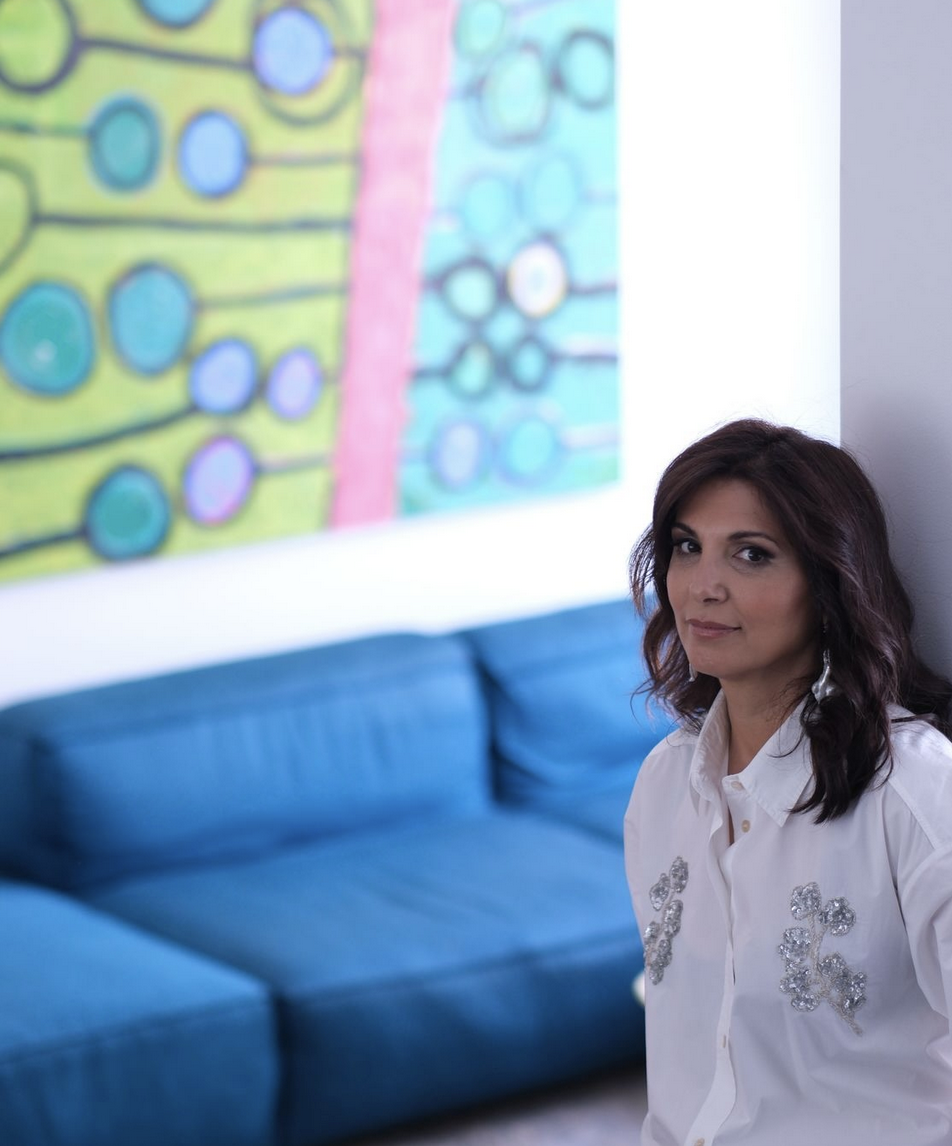
Asmaa Al-Shabibi is a visionary gallerist, curator, and strategist whose journey fuses cultural passion with bold entrepreneurship. Born in Baghdad and raised across London, Kuwait, and Bahrain, her multicultural upbringing shaped her perspective and deepened her commitment to championing diverse voices in the region’s art world.
From her early career in banking law, advising global financial giants, to co-founding Dubai’s renowned Lawrie Shabibi gallery, Asmaa has remained steadfast in her mission to elevate Arab artists and expand cultural dialogue. Here, she shares her insights on the transformative power of art, the importance of empowering women, and her hopes for the next generation of creators in the Middle East.
You were born in Baghdad and raised in London, Kuwait, and Bahrain. How did this multicultural upbringing shape your worldview and, ultimately, your eye for art?
I think this kind of upbringing was very important, as it exposed me to many cultures and gave me a much wider perspective. Although, as a child, I didn’t like moving around so much, it did make me adaptable. I suspect it also influenced the kind of artists I admire, those living in the diaspora who are interested in issues such as identity and belonging.
From banking law at Allen & Overy, advising global institutions like JP Morgan and Morgan Stanley, to founding one of Dubai’s leading art galleries, what made you leave the corporate world behind?
I left because, after ten years, I felt I didn’t want to advance my legal career further for lifestyle reasons. I needed more ownership over my life and wanted to express something more creative, although at the time, I had no clear idea what that would be.
What inspired you to co-found Lawrie Shabibi in Alserkal Avenue back in 2011, and what creative or cultural gap were you hoping to fill?
After my role as managing director of Art Dubai for three years, I felt a strong desire for more personal expression. Over coffee with William Lawrie (my current partner in the gallery, who was then the Middle East specialist at Christie’s), we realized the Gulf’s cultural landscape was changing. We predicted growing interest in Arab artists, especially with new museums opening. Our goal was to fill that cultural gap.
You’ve helped bring artists from the Middle East, North Africa, and Europe to global platforms. What do you look for when deciding to represent a new artist?
It’s often hard to pinpoint exactly what we’re looking for, when we see it, we know! But generally, we prefer artists with strong conceptual ideas, a connection to the region, and visually exciting work. Most importantly, we need to personally like the artist.
You’ve consistently championed overlooked or underrepresented voices, including female and mature artists. Why is this mission so personal to you?
I’ve thought about this a lot, and I believe it’s rooted in my sense of justice and fairness, similar to what motivated me to pursue law. Working with underrepresented art is also a form of soft activism for me.
What advice would you give to young women in the region aspiring to work in art—as gallerists, curators, artists, or entrepreneurs?
Confidence and a strong belief in what you do are the most important. The creative world is very personal, your work reflects you. Be prepared for critique and judgment. Stay open to learning and improving, and try to silence unhelpful self-criticism that hinders your progress.
What excites you most about the next generation of artists from the region?
The growth of exhibitions, institutions, and cultural initiatives offers many opportunities for young artists. In Qatar, Saudi Arabia, and the UAE, art and culture are high on the government agenda, enabling artists to step into the global arena with confidence. However, excelling as an artist also requires mentorship and critique, which I believe we need to embrace more fully.
You also founded Unit 21 Consulting, offering strategic advice to public and private art initiatives. What motivated this venture, and what impact do you hope it will have?
Our motivation was to work with corporate collections and independent artists outside of the gallery context. At that time, corporate collections were rare, but we worked on the Cleveland Clinic Abu Dhabi art collection. I believe the impact is evident, since then, many more corporate collections have emerged in the UAE.
You described art as “inherently political.” How do you navigate this belief when curating in a region with diverse, and sometimes sensitive, social dynamics?
Being from and of the region, I believe I have an advantage because I understand and respect our cultural sensitivities. I don’t find this challenging. So far, we have successfully curated thought-provoking exhibitions addressing complex social and cultural issues.
Text by Victor Gee.