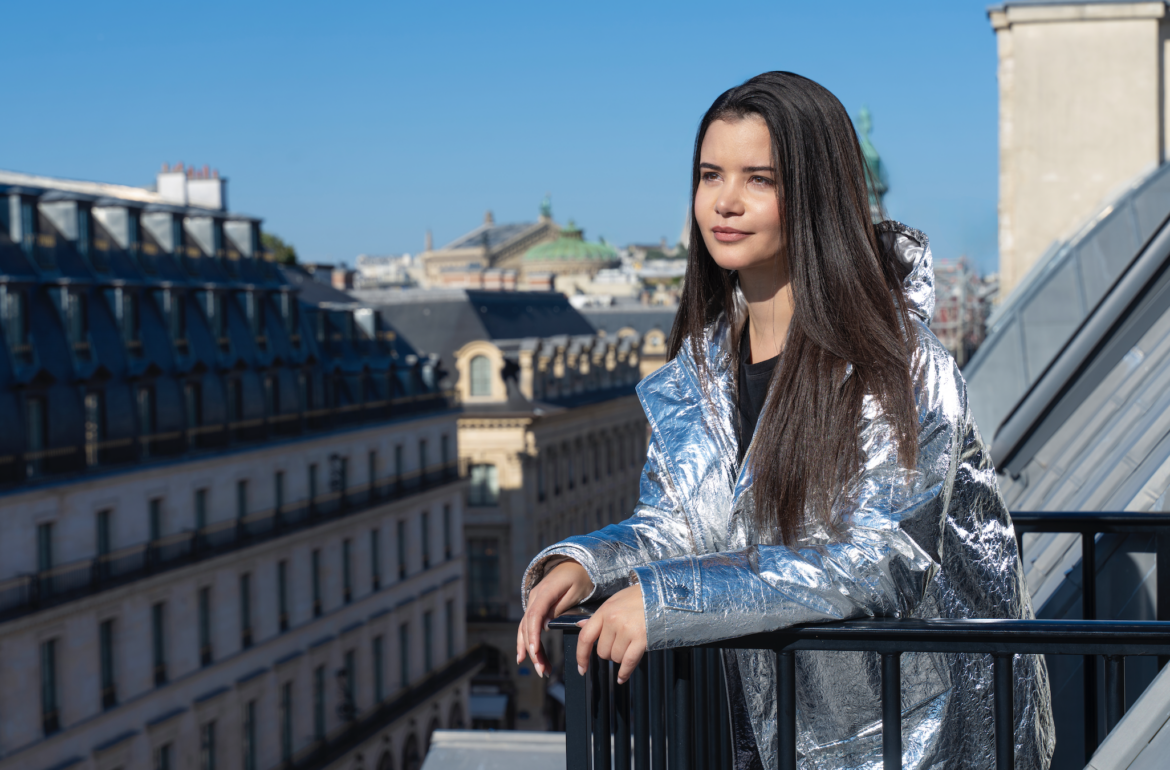
Growing up in Monastir, Tunisia, with the sea stretching endlessly before her and the sky above as a constant invitation, Rania Toukebri learned early to look beyond the visible horizon. Inspired by her uncle’s stories of NASA and captivated by each revelation from telescopes and space probes, her curiosity expanded outward—to the cosmos itself. Ballet instilled discipline and resilience, teaching her how to push past limits with grace. Space, once a childhood fascination, became a calling.
She went on to study engineering with a singular goal: to help build the spacecraft that carry humanity deeper into the unknown. Today, Rania has held key roles in major European Space Agency missions including JUICE, PLATO, HERA, and ARTEMIS—projects shaping how we understand our universe and our place within it. Recognized among Africa’s Top 10 Under 30 in Space, awarded the Trophée de la Réussite au Féminin, and selected as a mentor for the UN’s Space4Women programme, she embodies technical excellence guided by imagination, resilience, and purpose—driven not only to explore space, but to inspire the women who will follow her trajectory.
As a Tunisian woman in a male-dominated field, what challenges have shaped your journey?
Working in STEAM—and especially in space—is still male-dominated, though more women are stepping into leadership roles. Early on, being the only woman in the room was daunting; you have to prove your abilities and leadership. Those challenges pushed me beyond my limits and helped me understand my worth. I always focus on people’s skills, not their gender.
How did you learn to transform setbacks into resilience?
Doubts and failures are part of the journey. Resilience is a choice—a daily practice of showing up despite obstacles and trusting your vision.
Does being “the first” or “the only” woman ever feel like a burden?
Surprisingly, it’s exciting. I watch how others interact, then find my moment to contribute. Often, people are surprised when I succeed—but that strengthens my confidence and opens doors to projects many young people might hesitate to embrace.
Leading major space missions in Germany, what has this experience taught you?
Projects like JUICE, PLATO, HERA, and ARTEMIS push the boundaries of humanity’s understanding of space. Even in difficult moments, the significance of this work motivates me. Loving what I do and knowing its impact gives me focus and strength every day.
Do you feel you are building spacecraft—or shaping humanity’s future?
Every mission carries a part of me. Watching a spacecraft I helped build launch fills me with pride—not just in the work, but in being part of a team making it possible. Missions like HERA, PLATO, and Jupiter R-Simon have been thrilling and meaningful. PLATO, launching in 2026, will help discover other solar systems and planets like ours. It feels like sci-fi—except the discoveries are real.
Which project touched you most deeply, and why?
Space exploration starts with curiosity and imagination, then becomes pure science. Every detail must be precise—there’s no room for error. That combination of imagination and rigor makes this work so powerful.
You’ve received numerous honors and serve as a mentor for the UN’s Space4Women programme. Which recognition has meant the most to you?
Every recognition is meaningful. Being recognized on a continental level or for excellence in leadership is humbling. But mentoring for Space4Women touched me most. It’s about trust—guiding and inspiring other women. Awards are milestones, but mentorship gives deeper purpose: sharing knowledge and opening doors for those who follow.
What message do you hope young Tunisian girls take from your journey?
Success isn’t measured by awards, but by dreams, character, and creating something meaningful. Find what moves you, follow your path, and be yourself—fully and unapologetically. The world needs your voice.
Do you see humanity’s future among the stars—or here on Earth?
Space teaches collaboration, respect, and shared purpose. It reminds us of values we often forget on Earth and offers hope that we can overcome divisions. Space isn’t just discovery—it’s a lesson in living wisely, together.
When humans walk on the Moon knowing your work helped make it possible, what will that mean to you?
It will be indescribable. Helping humanity take its first steps on another world is the greatest honor. Reaching for the stars, we rise together.
Outside of work, what brings you joy and balance?
Dance, horseback riding, and art. They teach focus, strength, and creative freedom—and reconnect me with myself. Creativity grows alongside imagination and discipline.
Text: Suna Ahmed
Photographer: Nahoko Spiess
Dress:Eric Tibusch Silver Jacket: Possey
Location: Maison Barriere Vendôme